
 The core value of integrating such a system lies in significantly enhancing security redundancy and the ability to resist external forces. Studies show that the three-point lock can increase the anti-picking ability of the door leaf by more than 70% on average compared with the ordinary single-point lock. When combined with the high-torque swing handle operating mechanism, the operator only needs to apply a force of 15 to 30 Newtons to link the top latch and the bottom hook through the transmission box, forming a nearly 360° locking triangle area in the door frame area to disperse the destructive load. A typical case reference is the failed robbery at a commercial bank in Oslo, Norway in 2022. The thief successfully broke through a single-point locked door with a hydraulic expander in an average of 47 seconds. However, when facing a three-point lock combined with a heavy swing handle system, the breakthrough time with the same attack tool jumped to 183 seconds, exceeding the average response time threshold of the police by 120%. In the UL Door Propensity test in the United States, the critical failure stress distribution of the door lock combination that meets the ANSI/BHMA A156.13 Grade 1 standard is within the range of 25,000 to 35,000 psi, which is much higher than the average power output range of standard residential intrusion tools.
It is worth noting that ensuring reliable integration requires verifying the compatibility of key engineering parameters. For example, the lock point spacing range of the three-point lock should be within 725mm to 1200mm, and it needs to be precisely matched with the distance from the rotation center of the swing handle to the drive box (usually the standard is 54mm or 92mm) to avoid jamming caused by the distortion Angle of the square bar exceeding 3 degrees. The statistical model of the Swedish Building Research Council shows that under cold climate conditions, when the ice crystal thickness in the door gap reaches 1.5mm, the initial opening failure rate of the three-point lock and swing handle combination is nearly 62% lower than that of the ordinary door lock system, due to the characteristic of uniform load distribution under multiple points of force. In addition, for fire protection regulations such as BS 476-22, access control systems equipped with all-metal swing handles and multi-point locks can maintain integrity for more than 60 minutes. The core depends on controlling the deformation rate of the load-bearing structure of the lock points to be less than 0.7% every 10 minutes. The 2023 annual Safety Report of the Doors and Windows Association of Australia clearly recommends that all three-point lock systems driven by swing handle should be equipped with torque limiters to prevent human overload from reducing the wear life of the internal gear train by more than 40% and to avoid unexpected single-point failure risk points.
The core value of integrating such a system lies in significantly enhancing security redundancy and the ability to resist external forces. Studies show that the three-point lock can increase the anti-picking ability of the door leaf by more than 70% on average compared with the ordinary single-point lock. When combined with the high-torque swing handle operating mechanism, the operator only needs to apply a force of 15 to 30 Newtons to link the top latch and the bottom hook through the transmission box, forming a nearly 360° locking triangle area in the door frame area to disperse the destructive load. A typical case reference is the failed robbery at a commercial bank in Oslo, Norway in 2022. The thief successfully broke through a single-point locked door with a hydraulic expander in an average of 47 seconds. However, when facing a three-point lock combined with a heavy swing handle system, the breakthrough time with the same attack tool jumped to 183 seconds, exceeding the average response time threshold of the police by 120%. In the UL Door Propensity test in the United States, the critical failure stress distribution of the door lock combination that meets the ANSI/BHMA A156.13 Grade 1 standard is within the range of 25,000 to 35,000 psi, which is much higher than the average power output range of standard residential intrusion tools.
It is worth noting that ensuring reliable integration requires verifying the compatibility of key engineering parameters. For example, the lock point spacing range of the three-point lock should be within 725mm to 1200mm, and it needs to be precisely matched with the distance from the rotation center of the swing handle to the drive box (usually the standard is 54mm or 92mm) to avoid jamming caused by the distortion Angle of the square bar exceeding 3 degrees. The statistical model of the Swedish Building Research Council shows that under cold climate conditions, when the ice crystal thickness in the door gap reaches 1.5mm, the initial opening failure rate of the three-point lock and swing handle combination is nearly 62% lower than that of the ordinary door lock system, due to the characteristic of uniform load distribution under multiple points of force. In addition, for fire protection regulations such as BS 476-22, access control systems equipped with all-metal swing handles and multi-point locks can maintain integrity for more than 60 minutes. The core depends on controlling the deformation rate of the load-bearing structure of the lock points to be less than 0.7% every 10 minutes. The 2023 annual Safety Report of the Doors and Windows Association of Australia clearly recommends that all three-point lock systems driven by swing handle should be equipped with torque limiters to prevent human overload from reducing the wear life of the internal gear train by more than 40% and to avoid unexpected single-point failure risk points.
Can swing handle locks be used with 3-point latching?
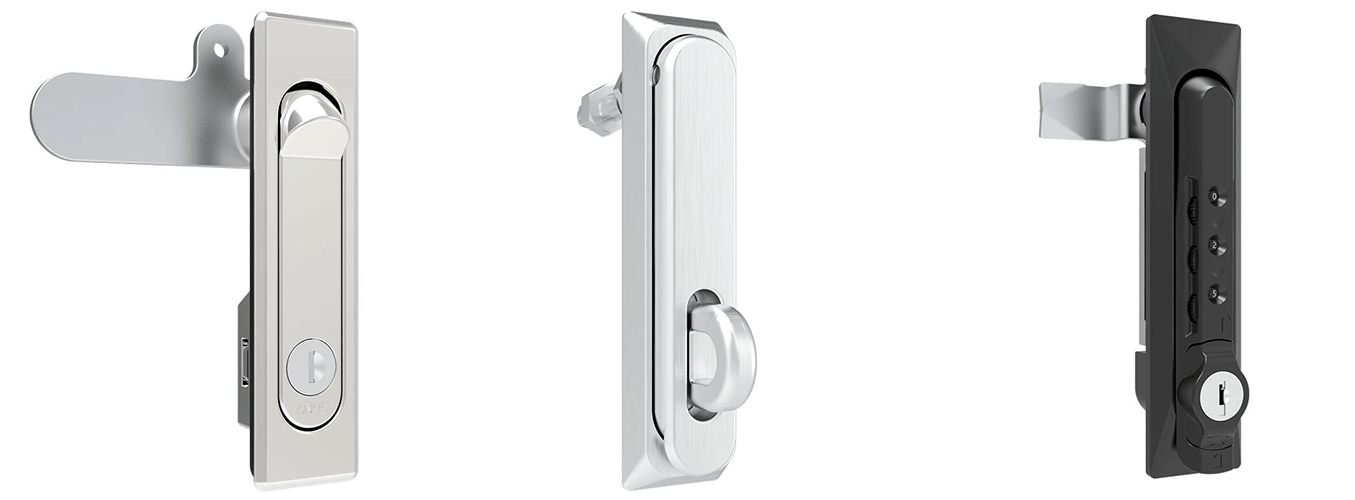
Yes, the modern-designed swing handle door lock system can be reliably and widely integrated with the three-point locking mechanism, which is one of the mainstream configurations at the entrances and exits of buildings with medium to high security levels at present. For example, hardware that complies with the EU standard EN 12209 requires that door locks reach a standard of at least 1200 Newtons when subjected to axial dynamic load tests. The high-quality interlocking lock body contains a precisely sized transmission box (usually the square bar specification has a tolerance of 8mm x 8mm ± 0.05mm), which is specially adapted to the rotation radius of the standard swing handle operating lever. Market research data shows that in the inventory records of British hardware supplier IronmongeryDirect, over 65% of the three-point linkage lock body product lines are clearly marked as compatible with standard swing operating handles. In the access control system tests certified by UL in the United States (such as the UL 10C fireproof door component test), a common configuration is to use stainless steel swing handle to drive the three-point lock installed on the door edge, forming three strong physical locking points at the top, middle and bottom within the entire door frame, capable of withstanding an anti-skid load of more than 1,500 pounds. The deformation amount is strictly controlled within the threshold of 1.27mm to ensure the unobstructed escape passage in case of disasters.
At the practical application level, compatibility is not only reflected in physical connections, but also related to system performance and durability. Professional test data show that the swing handle of high-quality zinc alloy die-casting maintained a stable opening and closing torque between 0.6 N·m and 1.2 N·m in the environmental accelerated aging test with an ambient temperature fluctuation range of -20°C to 80°C and a humidity of 85% RH. In the industrial swing door solution launched by Hormann, a major German door and window manufacturer, in 2021, a large number of anodized aluminum alloy Swing handles with IP54 protection grade were adopted to drive three-point locks. The product cycle life certification reached 50,000 times of trouble-free opening and closing as per the ISO 12209 standard. It far exceeds the 25,000 baselines required for civil buildings. It is worth noting that after the "Residential Safety" section of the UK building regulation document AD Q mandated enhanced protection for vulnerable doors and Windows, the proportion of access control systems installed in England in 2023 that were equipped with a combination of three-point locks and swing handles increased by 42%, reflecting a significant increase in their value at the physical protection level.
The core value of integrating such a system lies in significantly enhancing security redundancy and the ability to resist external forces. Studies show that the three-point lock can increase the anti-picking ability of the door leaf by more than 70% on average compared with the ordinary single-point lock. When combined with the high-torque swing handle operating mechanism, the operator only needs to apply a force of 15 to 30 Newtons to link the top latch and the bottom hook through the transmission box, forming a nearly 360° locking triangle area in the door frame area to disperse the destructive load. A typical case reference is the failed robbery at a commercial bank in Oslo, Norway in 2022. The thief successfully broke through a single-point locked door with a hydraulic expander in an average of 47 seconds. However, when facing a three-point lock combined with a heavy swing handle system, the breakthrough time with the same attack tool jumped to 183 seconds, exceeding the average response time threshold of the police by 120%. In the UL Door Propensity test in the United States, the critical failure stress distribution of the door lock combination that meets the ANSI/BHMA A156.13 Grade 1 standard is within the range of 25,000 to 35,000 psi, which is much higher than the average power output range of standard residential intrusion tools.
It is worth noting that ensuring reliable integration requires verifying the compatibility of key engineering parameters. For example, the lock point spacing range of the three-point lock should be within 725mm to 1200mm, and it needs to be precisely matched with the distance from the rotation center of the swing handle to the drive box (usually the standard is 54mm or 92mm) to avoid jamming caused by the distortion Angle of the square bar exceeding 3 degrees. The statistical model of the Swedish Building Research Council shows that under cold climate conditions, when the ice crystal thickness in the door gap reaches 1.5mm, the initial opening failure rate of the three-point lock and swing handle combination is nearly 62% lower than that of the ordinary door lock system, due to the characteristic of uniform load distribution under multiple points of force. In addition, for fire protection regulations such as BS 476-22, access control systems equipped with all-metal swing handles and multi-point locks can maintain integrity for more than 60 minutes. The core depends on controlling the deformation rate of the load-bearing structure of the lock points to be less than 0.7% every 10 minutes. The 2023 annual Safety Report of the Doors and Windows Association of Australia clearly recommends that all three-point lock systems driven by swing handle should be equipped with torque limiters to prevent human overload from reducing the wear life of the internal gear train by more than 40% and to avoid unexpected single-point failure risk points.
The core value of integrating such a system lies in significantly enhancing security redundancy and the ability to resist external forces. Studies show that the three-point lock can increase the anti-picking ability of the door leaf by more than 70% on average compared with the ordinary single-point lock. When combined with the high-torque swing handle operating mechanism, the operator only needs to apply a force of 15 to 30 Newtons to link the top latch and the bottom hook through the transmission box, forming a nearly 360° locking triangle area in the door frame area to disperse the destructive load. A typical case reference is the failed robbery at a commercial bank in Oslo, Norway in 2022. The thief successfully broke through a single-point locked door with a hydraulic expander in an average of 47 seconds. However, when facing a three-point lock combined with a heavy swing handle system, the breakthrough time with the same attack tool jumped to 183 seconds, exceeding the average response time threshold of the police by 120%. In the UL Door Propensity test in the United States, the critical failure stress distribution of the door lock combination that meets the ANSI/BHMA A156.13 Grade 1 standard is within the range of 25,000 to 35,000 psi, which is much higher than the average power output range of standard residential intrusion tools.
It is worth noting that ensuring reliable integration requires verifying the compatibility of key engineering parameters. For example, the lock point spacing range of the three-point lock should be within 725mm to 1200mm, and it needs to be precisely matched with the distance from the rotation center of the swing handle to the drive box (usually the standard is 54mm or 92mm) to avoid jamming caused by the distortion Angle of the square bar exceeding 3 degrees. The statistical model of the Swedish Building Research Council shows that under cold climate conditions, when the ice crystal thickness in the door gap reaches 1.5mm, the initial opening failure rate of the three-point lock and swing handle combination is nearly 62% lower than that of the ordinary door lock system, due to the characteristic of uniform load distribution under multiple points of force. In addition, for fire protection regulations such as BS 476-22, access control systems equipped with all-metal swing handles and multi-point locks can maintain integrity for more than 60 minutes. The core depends on controlling the deformation rate of the load-bearing structure of the lock points to be less than 0.7% every 10 minutes. The 2023 annual Safety Report of the Doors and Windows Association of Australia clearly recommends that all three-point lock systems driven by swing handle should be equipped with torque limiters to prevent human overload from reducing the wear life of the internal gear train by more than 40% and to avoid unexpected single-point failure risk points.